
Look for loops – a sustainable habit of mind
Move beyond the temptation to see the world as a linear sequence of events
and look for loops of cause and effect in the world surrounding you.
Identifying the drivers of continuity and change can help you understand the
world around you and identify opportunities to create change.
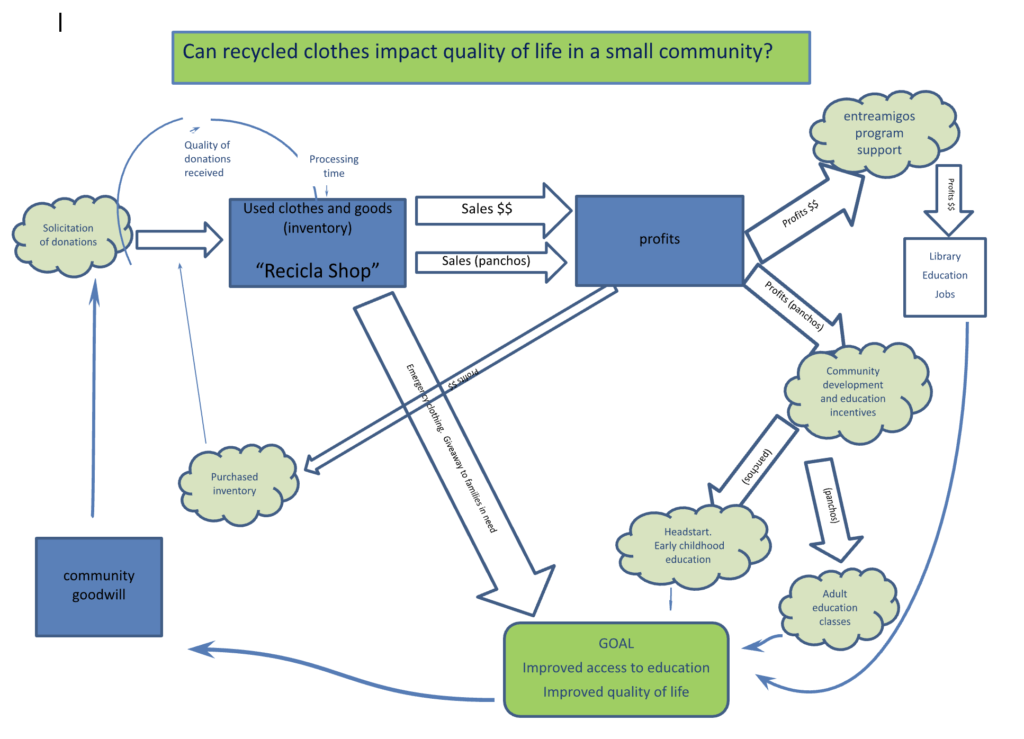
Nearly 20 years ago I started an education non-profit on my kitchen table in a small beach village in Mexico. A few days ago I was filtering through some old documents and came across this image reflecting the thinking behind one of our small enterprises, known as the “Recicla Shop” and it spurred me to share how the design of the store became a model of sustainable community design through the practice of looking for loops.
I have had the beautiful opportunity to witness the goodness of people. From the first days that we opened our doors, people brought me donations in the form of items that they no longer needed but imagined that someone else might be able to use. My very first “donation” was a surfboard, the next a few bamboo kitchen curtains and then extra house paint, broken tiles for mosaics and clothes, lots of clothes. At first it was fun to receive and redistribute these things but soon there was more than we knew what to do with or knew who might need them. The items began to pile up but we kept receiving them because it seemed to give such joy to those who brought them in, and well… surely someone would need them, right? But who, and how do you know?
Our organization was committed to the 4 R’s…. refuse, reduce, reuse and recycle. We were also committed to identifying opportunities to accelerate the circular economy, although this was well before there were guides showing how to do this. We just believed that our community was a source of unlimited resources and if we cared for each other and cared for our environment, we could grow together in a sustainable way. As the clothes continued to pile up and well meaning donors began to bring even more items that they didn’t need and figured that we could distribute, we found ourselves drowning in well intended contributions of the most random of things… a few hula hoops, an electric breast milk pump, well used lawn furniture, an inflatable swimming pool.
One of the challenges of developing community projects in places where there are huge differences in economic resources is to figure out how to grow collectively, support those most in need but somehow not perpetuate the stereotypes and colonization practices that drive deeper divisions.
The expectation of our donors was that we would give their contributed items to the “poor people.” In our town that might mean to wander to the makeshift palapa roofed shacks along the river or the families in our scholarship program. But there was no way to know if they really needed these things, if the clothes fit their family or if they had electricity or knowledge of what a breast pump is and why you would use it. The label itself, the “poor people” and the assumption that surely they will be happy to take off our hands whatever extras we have is condescending, judgemental and wholly against the very standards of dignity, choice and empowerment that we believed in. Yet, this act of giving was intended as an act of love and… surely there are many people with real needs and we had a growing storehouse of items and a real responsibility to find them their new home.
As a community practice our organizational platform consisted of valuing assets well beyond money. The organization “Entreamigos” was about living and sharing among friends and so we sat together to begin to imagine how we could distribute our donated items in a way that supported the community building intention of the organization. We knew that although a direct exchange of goods to those in need would be helpful, it would be difficult to do efficiently or to fairly administer. As we challenged ourselves to think more broadly, we used the power of systems mapping to identify the ways that many projects and programs are interconnected. The question that we asked ourselves was, “How can recycled clothes impact the quality of life in a small community?” The graphic represents the ways that we were able to zoom out of the immediate challenge of distributing donated goods to embrace the practice and purpose of the entire organization.
If you follow the arrows and look for loops, you will see that we were able to create many interlocking and beautifully reinforcing circles of love, empowerment and value. Our intention was to honor those that made contributions through reaping the greatest value from their contributions.
Follow along in this example…
- Good, thoughtful, kind people donate used items
- These items are cleaned and displayed nicely, creating jobs for local staff
- They are sold in our “Recicla Shop” for pesos, raising revenue to pay our staff and keep the cycle going.
- They are also sold for “panchos” (a local currency that we created)
- Panchos can be earned through attending our adult education classes and parent workshops – these are classes designed for our scholarship student parents or any of our staff members or community members who want to learn more about early childhood, violence prevention, sexual safety and a myriad of other topics taught by professionals.
- Parents who invested their time in developing their personal and parenting skills would be gifted panchos to purchase items in our Recicla Shop that would be useful to them and their families.
- Sometimes, our own staff who worked tirelessly for many more hours than they were fairly compensated for, would also receive panchos.
These panchos, spent and received were “guaranteed” by the incoming flow of donated goods which supported the continuous loop of good intentions being realized in the recognition of amazing people working to better themselves, their families and their communities. These same people could purchase the items that they most needed, the clothes that fit their size and style, or the fun novelty, like that hula hoop or inflatable pool. Community goodwill brought us all together in a way that created value and and we could feel valued.
The practice of looking for loops is about seeing beyond the immediate and the transactional, it is about recognizing that everything that you do, or are, or put into the world has an impact and in some way will come back to you. It is not, though, an indiscriminate karmic consequence but rather it can be a practice, a sustainable ‘habit of mind’ where we learn to look for the connections and paths that support the outcomes that we hope to see and recognize the ripple effect of all that we do. Looking for loops is the practice of intentionally designing for and contributing to a better, more sustainable world.